Commercial asphalt repair · Colorado
How to Plan Parking Lot Repairs in Denver
A parking lot rarely fails all at once. It starts with a crack near a drain, a soft spot by the dumpster pad, or a pothole at the entrance that shows up after the first hard freeze. Caught early, those problems are cheap repairs. Left alone through a Denver winter, they turn into resurfacing projects.
| Condition | Repair to evaluate | What to check |
|---|---|---|
| Individual cracks in solid pavement | Crack sealing | Surrounding pavement and water entry |
| Alligator cracking, soft spots, or failed sections | Full-depth patching | Drainage and the base underneath |
| Potholes | Temporary winter repair or permanent hot-asphalt patch | Access, repair timing, and recurring failures |
| Widespread failures | Milling and overlay or reconstruction | Surface condition, drainage, and base support |
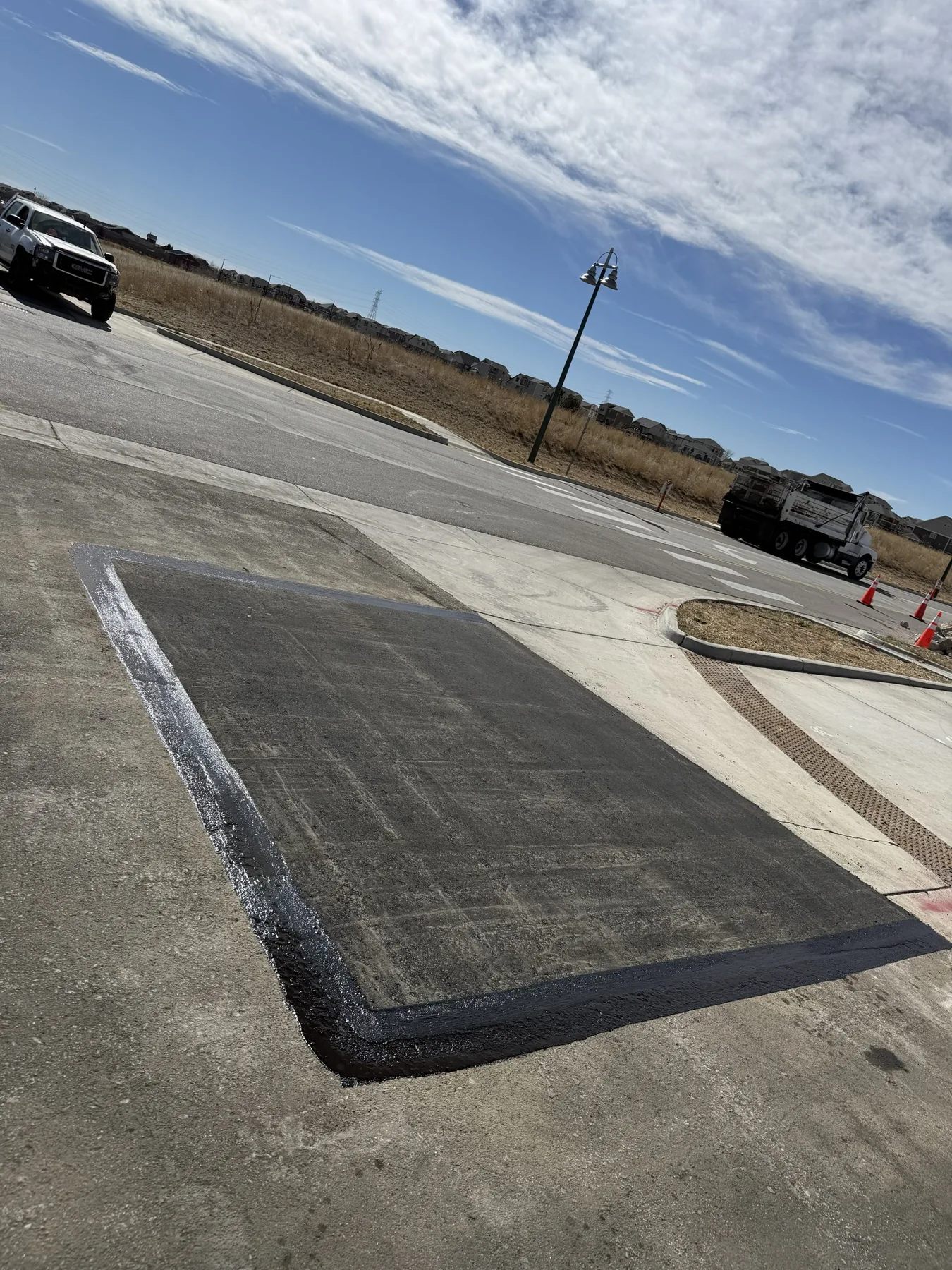
Commercial asphalt repairs along the Front Range
This guide covers the commercial asphalt repairs property managers, HOA boards, and facility teams deal with most often along the Front Range, what each one fixes, and how to plan the work around a property that has to stay open.
Why Denver asphalt breaks down
Colorado pavement takes a beating from three things at once:
- Freeze-thaw cycles. Water gets into cracks, freezes, expands, and pries the asphalt apart. The Front Range swings above and below freezing many times each winter, so this happens over and over.
- Sun and UV. High-altitude sun dries out the asphalt binder, which makes the surface brittle and gray and more likely to crack.
- Heavy, repeated loads. Delivery trucks, trash trucks, and snow plows concentrate weight on the same paths every day, especially at entrances, loading areas, and dumpster pads.
Repairs work best when they address the cause, not just the hole. That is why a good repair starts with looking at drainage and the base under the damaged area.
When to crack seal
Cracks are the entry point for water, and water is what destroys the base under your pavement. Crack sealing fills and seals those cracks with a hot-applied rubberized sealant so water stays out.
When it makes sense:
- Individual cracks, edge cracks, and joints where the surrounding pavement is still solid
- Before winter, so cracks are sealed ahead of the freeze-thaw season
- Before sealcoating, so the sealcoat goes over a sealed surface
When it does not: Areas covered in interconnected "alligator" cracking usually mean the base underneath has failed. Sealing those cracks will not hold. That area needs a patch.
Commercial asphalt patching methods
Patching replaces a damaged section of pavement instead of the whole lot. For most commercial properties, this is the core of an annual repair budget.
Common patching methods:
- Remove and replace (full depth). The failed asphalt is cut out, the base is checked and corrected, and new hot asphalt is placed and compacted. This is the durable fix for alligator cracking, soft spots, and areas where the base has failed.
- Skin or overlay patching. A thin layer of asphalt over a sound but worn area. It is faster and cheaper, but it only works when the pavement underneath is still stable.
- Infrared patching. The existing asphalt is heated, reworked, and blended with new material. It works well for some surface defects and seamless repairs, but it is not a fix for base failure.
Signs an area needs a patch, not a crack seal:
- Alligator or "spiderweb" cracking
- Depressions or low spots that hold water
- Ruts in drive lanes or at entrances
- Crumbling edges along curbs and landscaping
Pothole repair in Denver: temporary and permanent fixes
Potholes are the repair tenants and customers notice first, and they create the most liability. In Denver they spike in late winter and early spring, after months of freeze-thaw.
Short term: cold patch can make a pothole safe in winter when asphalt plants are limited, but it is a temporary fix that tends to loosen under traffic.
Long term: the pothole should be cut out and permanently patched with hot asphalt once conditions allow, with the base checked underneath. A pothole that keeps coming back in the same spot almost always points to a drainage or base problem.
If a pothole is at an entrance, ADA route, or fire lane, treat it as an emergency asphalt repair and get it made safe right away.
When repairs are enough, and when to resurface
Repairs are the right call when damage is isolated. Once failures cover a large share of the lot, repairing piece by piece can cost more than milling and overlaying the whole surface.
A simple rule of thumb:
- Scattered cracks and a few failed spots: crack seal and patch
- Widespread surface wear, but a sound base: mill and overlay
- Widespread base failure, drainage problems, or many patches failing: reconstruction
For a deeper look, see our guide: Repair, Resurface, or Replace Your Colorado Parking Lot?
Keeping the property open during repairs
Repairs on an occupied site come down to planning access. Before work starts, settle:
- Which entrances and delivery routes must stay open, and when
- Phasing, so one section is repaired while traffic uses another
- Timing around business hours, trash pickup, and tenant deliveries
- Restriping of any patched areas that cross stall lines, fire lanes, or ADA markings
- Notices to tenants or residents about closures
A clear scope that spells this out up front avoids most of the complaints that come with pavement work.
A yearly repair schedule for Denver properties
The lowest-cost parking lots are the ones on a schedule. A simple yearly cycle for a Denver property:
- Spring: walk the lot after winter, mark potholes and failed areas, and permanently patch them
- Summer: handle larger patching, sealcoating, and restriping while temperatures support the work
- Fall: crack seal ahead of winter
- Winter: make emergency repairs safe and track problem areas for spring
For a full program, see A Pavement Maintenance Plan for Colorado Property Managers and HOAs.
Plan your commercial asphalt repair
MD Asphalt Co. handles commercial asphalt repair, patching, crack sealing, and pothole repair for property managers, HOAs, municipalities, and commercial facilities. For a Denver property, see our Denver parking lot repair service. Coverage also extends across the Front Range and Northern Colorado.
Send the property address, a few photos of the problem areas, and your timing, and we will help you sort out what needs patching now and what can wait.
Request a site assessment or call (720) 307-1296.