
Choosing the work · Colorado
Repair, Resurface, or Replace Your Colorado Parking Lot?
Choose the treatment from the condition of the pavement and its support, not its age alone. Isolated failures may suit repairs; broader surface wear may suit resurfacing after preparation; extensive structural problems may require rebuilding. MD Asphalt helps Denver and Front Range property teams evaluate these options and considers larger projects throughout Colorado.
| Option | What it addresses | What must be checked |
|---|---|---|
| Localized repair | Specific failed areas | Cause, boundaries, support, and surrounding pavement |
| Resurfacing / overlay | A broader worn surface | Remaining structure, repairs, drainage, and finished height |
| Reconstruction | Pavement requiring rebuilding | Removal limits, support, design, and vehicle use |
What should you inspect before choosing a treatment?
Start with a map of the lot and observations tied to locations. Mark potholes, cracking, depressions, worn surfaces, and previous repair boundaries. Record where water collects and where vehicles turn, brake, or stand. A description such as “the lot looks old” does not distinguish a worn surface from pavement that is moving under load.
Photograph both the symptom and the surrounding area. A close photograph shows a crack; a wider view shows whether it sits beside a drain, along a utility trench, or within a truck route. Keep the date and location with each image. If you have maintenance records, note whether the same area has needed repeated attention.
A visual walk is a starting point. The level of further investigation depends on the uncertainty: existing pavement records, thickness checks, test areas, or other evaluation may be needed before recommending an overlay or reconstruction. Ask what the assessment establishes and what remains unknown. No photograph can prove that an entire lot has sound support below its surface.
Colorado weather adds a reason to document water movement carefully. CDOT explains how water and freeze-thaw cycles contribute to potholes. That mechanism does not mean every crack is caused by winter. Loading, construction, drainage, and underlying conditions still need to be considered together.
When can targeted repairs preserve the rest of the lot?
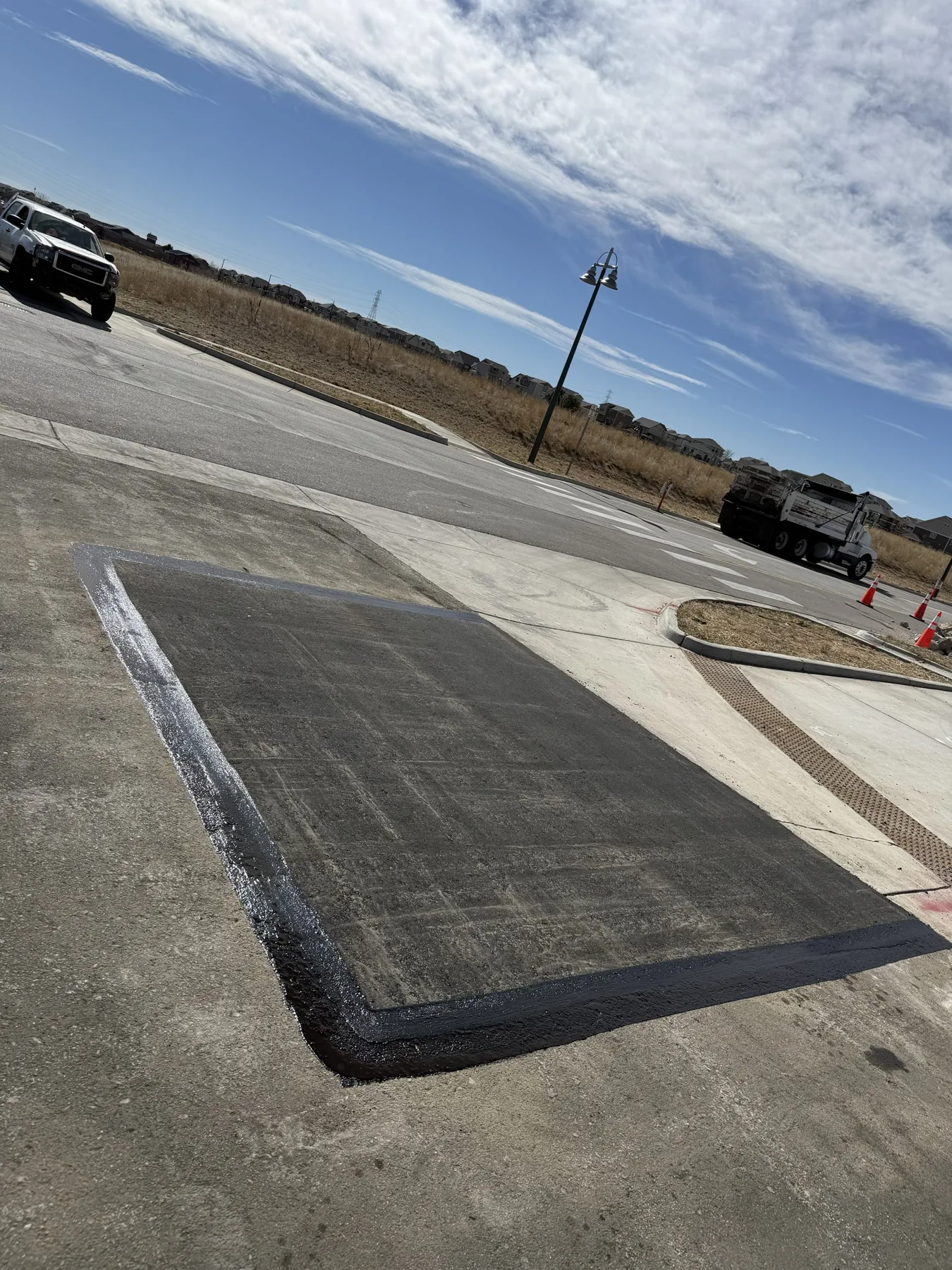
Targeted repair is worth evaluating when the failures are confined to identifiable areas and the surrounding pavement can remain useful. The repair should address the depth and extent of the failure. A thin surface treatment cannot replace missing support beneath a depressed or broken section. The purpose is to restore the failed area while retaining pavement that does not need removal.
Ask the estimator to mark proposed repair limits and explain why those limits were selected. The visible hole may be smaller than the area that needs to be removed. If weak or wet material appears during excavation, the owner needs a defined way to review the additional repair before new asphalt covers it.
Localized work can be especially useful where one utility cut, loading approach, or drainage problem is causing repeated damage. It is less convincing as a long-term plan when failures are expanding across the lot and each round of work simply follows the last. Repeated patches are evidence to review, not an automatic instruction to replace every paved area.
Ask for the expected purpose of each repair: reduce an immediate hazard, restore a specific failed area, or prepare the lot for later resurfacing. These goals have different implications for what follows. The patching and repair service page outlines the work MD Asphalt evaluates for damaged pavement.
When does resurfacing make sense?
An asphalt overlay adds a new asphalt layer over a prepared existing surface. It is an option to assess when enough of the supporting pavement remains suitable for the proposed use. Preparation may include localized repairs, milling, cleaning, and drainage corrections. The decision requires more than checking whether the new asphalt will look better.
Finished elevations are a separate question from structural condition. Adding material can change the relationship to curbs, drains, entrances, and adjoining pavement. Milling can remove existing asphalt to make room for the new layer, but the required depth and limits depend on the design. A proposal should state how the finished surface will meet each important boundary.
Existing cracking also matters. Ask the contractor to explain which cracks can be addressed in preparation and which conditions increase the risk of distress returning through the new layer. The Asphalt Institute's parking-lot repair guidance identifies interconnected alligator cracking as a possible sign of load-related structural failure. That pattern calls for investigation of its cause and extent.
Resurfacing is not the right choice simply because it allows less removal. If the lower layers cannot support the intended traffic, a surface-only plan leaves that problem unresolved. The milling and overlay guide explains how removal, repairs, finished height, and paving fit together.
When should you evaluate reconstruction?
Reconstruction deserves evaluation when the existing pavement cannot be made suitable through reasonable localized repairs and resurfacing. The assessment may identify extensive support problems, a pavement section unsuitable for the intended loading, or geometry that needs more substantial correction. The removal and rebuilding limits should follow that evidence, not a blanket rule based on pavement age.
Ask whether the conclusion applies to the whole property or only particular zones. A truck service area may need a different section from employee parking. A lot with extensive failures at one entrance may still contain useful pavement elsewhere. Dividing the property into logical areas helps the owner compare a staged project with an all-at-once approach.
For larger Colorado projects, the proposal may need to work from an engineer's design or project-specific requirements. Clarify who is responsible for that design, any needed investigation, and coordination with the relevant local authority. An article cannot establish the correct base, asphalt thickness, or drainage design for a particular property.
Reconstruction also changes the access discussion. Excavated areas cannot serve as ordinary parking or traffic lanes during the work. Before selecting a schedule, identify alternative access, deliveries, tenant communication, and the sequence for reopening finished areas. A sound technical recommendation still needs a practical plan for keeping the property operating.
How can a condition map improve the decision?
Consider this illustrative planning exercise, not a completed MD Asphalt project. A property contains three distinct areas: a 12,000-square-foot parking field, a 4,000-square-foot entrance and drive lane, and a 2,000-square-foot loading area. The total is 18,000 square feet. Label them A, B, and C so every photograph and proposal can refer to the same boundaries.
Suppose observations show surface wear in A, recurring depressions in B, and broken pavement where trucks turn in C. Those observations do not prescribe three particular treatments. They establish three questions for assessment: can A support an overlay, what is causing movement in B, and is C suitable for the loading it receives? Measuring the areas keeps those questions from being lost in a single whole-lot price.
Ask each contractor to explain their recommendation for all three areas on the same map. One proposal might assume repairs in B and C before resurfacing; another might call for rebuilding C. The owner can now compare the evidence and quantities behind those choices. The next step is to resolve differences in diagnosis, rather than choose the lowest total by itself.
Keep a separate entry for uncertainty. If the extent of a failed base will only become clear after removal, record the repair allowance, pricing method, and person authorized to approve a change. The map becomes a useful reference for the completion walk and future maintenance records as well as the initial bidding process.
What should property managers ask before approving work?
Ask for the reason behind the recommended treatment, the alternatives considered, and the conditions that would change the recommendation. A useful answer connects the work to observed pavement problems. It should distinguish what has been verified on site from what is still assumed. If a recommendation depends on information not yet collected, resolve that gap before committing to a final scope.
For any option, review the work boundary, removal and preparation, drainage transitions, asphalt placement, markings, and access plan. Identify excluded work such as adjacent concrete or utility adjustments. Ask when the surface can reopen under the actual conditions and proposed materials; do not substitute a generic time from an online article for the project's instructions.
Review the operational cost of each sequence alongside the construction proposal. A phased project may preserve parking but require more coordination. A larger closure may simplify construction yet conflict with tenant activity. Give every bidder the same access restrictions, so the treatment comparison is not distorted by different assumptions about how much of the lot can close.
This guide supports a planning discussion, not a remote diagnosis or a promise that one treatment will last a fixed number of years. MD Asphalt's commercial property-management services cover pavement planning for occupied properties. Send the Colorado address, condition photos, known repair history, and approximate area to begin a scope discussion. Larger projects beyond the Front Range are evaluated for statewide travel.
Common questions
Can sealcoating replace an asphalt overlay?
No. Sealcoating is a surface maintenance treatment for suitable pavement, while an asphalt overlay adds an asphalt layer. Neither should be specified as a cosmetic answer to failed support. Have the condition assessed first, then compare the treatment intended to address it. A lot can need repairs before either maintenance or resurfacing.
Does alligator cracking mean the entire lot must be replaced?
Not automatically. Interconnected cracking can indicate a structural problem, but the extent and cause matter. An evaluation should distinguish isolated failed sections from broader deterioration. Ask for repair boundaries and evidence about support and loading before deciding whether localized repairs, resurfacing after repairs, or reconstruction is appropriate.
Can an HOA complete the work in phases?
Phasing may be possible when the layout, work scope, and access requirements allow it. Ask for a sequence that addresses resident parking, deliveries, pedestrian routes, notifications, and reopening. The contractor should assess whether each phase can function on its own and explain how unfinished and completed areas will connect.